 On the lower floor of thtional Gallery, in mind from the museumagnificent Italian collection, there’s a little picture of the mother who’s handing carnations towards the baby on her behalf lap. The shades from the painting, although a lot more than five centuries old, are wealthy and luminous. The materials from the woman’s dress are thoroughly folded as the tracery of veil round her mind is portrayed with breathtaking skill.
This really is Raphael’s The Madonna from the Pinks, which isn’t only among the gallery’s finest works – a painting of “concentrated magnetism”, based on the historian Lisa Jardine – but one by having an unpredicted provenance. For a long time, the initial was considered to happen to be lost until Nicholas Cent, at that time a curator, however the director from the National Gallery, visited Alnwick castle in Northumberland in 1991 and observed that which was presumed to become a copy from the painting but that was mounted within an costly, ornate frame. Why give this type of lavish setting to some mere copy? he wondered.
Cent had the image come to the gallery’s conservation department where infrared images revealed a fantastically performed drawing from the Madonna and child beneath its layers of fresh paint. The impact of the discovery was profound, as is going to be revealed using the opening from the National’s exhibition, Close Examination: Knockoffs, Mistakes & Breakthroughs. The show remembers the groundbreaking work from the gallery’s scientific department with The onna from the Pinks developing a vital area of the exhibition.
“Infrared images from the Alnwick painting demonstrated the wood panel of the small, devotional work had first been engrossed in a plaster-like substance known as gesso after which covered inside a quite thick layer of off-whitened oil fresh paint,” states Dr Ashok Roy, director of scientific research in the gallery. “Utilizing a metal point, the artist had then attracted lines at first glance, including elaborate hatchings, to produce a detailed drawing from the Madonna and her child. He then colored regarding this, following a outlines carefully.”
The metal point, by itself, was superbly crafted although it contained periodic tell-tale variations – within the costume and background landscape – in the picture the artist eventually colored regarding this. It was no copy, Cent came to the conclusion, for no painter would devote such attention and care if he was basically creating a likeness of some other painting. This needed to be considered a genuine Raphael.
Further research vindicated this interpretation. The painting’s under-drawing was in comparison with one discovered beneath an authenticated picture by Raphael, a piece referred to as The Small Cowper Madonna, within the National Gallery of Art in Washington, and was discovered to be much the same in fashion. Permanently measure, it had been learned that powdered bismuth, a unique pigment preferred by Raphael, have been utilized in the Alnwick painting, adding further evidence of its authenticity. (The Madonna from the Pinks, considered to happen to be colored in 1507, will get its title in the flowers the mother and child are handing one another: they are pinks, symbols of marriage. Thus the image is showing the Virgin Mary as not just mom however the bride of Christ.)
Following a huge public appeal, the image was eventually bought for £35m in 2004 in the Duke of Northumberland, although the purchase would not have happened been with them not been for Penny’s inspired detective work. Equally, with no work from the gallery’s researchers to back him, the Alnwick painting’s true origin might have continued to be uncertain and also the crowds that now flock towards the National could be missing out on a sight from the painting.
Today, techniques including infrared imaging, in addition to x-ray photography, electron microscopy and mass spectrometry, most of them developed through the National Gallery, are cornerstones in the commercial of art curation. And from time to time their use makes head lines, as was the situation with The Madonna from the Pinks. Indeed, there has been a couple of remarkable knockoffs and several problematic attributions uncovered through the gallery’s researchers within the decades, because the Close Examination exhibition will demonstrate.
Consider The Virgin and Child By having an Angel, that was acquired through the gallery in 1924 and that was allegedly the job from the Renaissance painter Francesco Francia. It had been eventually proven, because of fresh paint analysis and infrared photography, to become a late 19th-century forgery. Similarly, in 1874, the gallery bought two Botticelli works of art – Venus and Mars and An Allegory – in an auction of works collected by Alexander Barker. The greater pricey of these two, An Allegory, was subsequently revealed to become a contemporary imitation of Botticelli’s work. Both is going to be proven in the exhibition inside a display about taste and connoisseurship.
However, it might be an error to see the job from the gallery’s researchers to be mainly worried about the exposure of knockoffs, states Ashok Roy. “It might be completely incidental if your painting was discovered to be a fake throughout the path of our research. We’re mainly worried about helping conservation, focusing on how an image is made, revealing what techniques were utilized in its painting and explaining why individuals techniques were employed to begin with.”
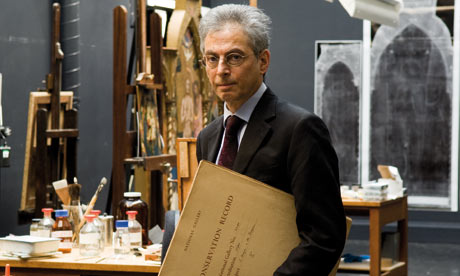
A rather built, dapper figure, outfitted inside a nicely pressed blue shirt, dark tie and black pants, Roy is crisply articulate about using technology to understand more about great art. He presides on the suite of rooms towards the top of the nation’s Gallery where he and the co-workers are actually meticulously examining the gallery’s entire assortment of works of art to show the strategies of their creation. One room is centered with a effective research microscope while some type of computer screen shows a red-colored-and-blue mix-portion of a sliver of fresh paint. You can observe, precisely, from images from the pigment layers the way the artist first colored his canvas dark blue after which added an overlay of crimson. The benches nearby are thrown with sample phials with minute specks of fresh paint inside them.
The department also offers a sizable electron microscope, full of spectrometer along with a library dedicated to art conservation and also the technical study of works of art. It’s a completely impressive set-up, though Roy appreciates that it is most significant feature isn’t the equipment however the gallery itself. “From the great collections around the globe, the nation’s Gallery is, effectively, probably the most comprehensive,” he states. You will find 2,400 works of art within the gallery and most 80 percent take presctiption display. Unlike a number of other museums or galleries, couple of works are stored in shops from public sight.
The important point would be that the National Gallery collection, while not huge like this from the Louvre, has tremendous breadth. All European schools are symbolized. “Here the thing is the real length of European painting that is possible at just 3 or 4 other, far bigger collections, such as the Louvre and also the Prado. By comparison, a gallery such as the Uffizi in Florence, although an excellent collection, is actually only worried about Italian painting in the early 14th century towards the 16th century. It informs us nothing about Rembrandt, for instance.”
Placed in 1934, the gallery’s science department is among the earliest on the planet and it is staff have acquired a higher status for his or her research of Europe’s great works of art and artists. Consider for example the job that’s been done there on Raphael. Together with Vermeer, Van Eyck, Leonardo yet others, he’s emerged – from scientific scrutiny – being an exponent from the precise, restrained use of fresh paint, a painter who upset absolutely everything together with his sketches – a hands here, just a little sketch from the Virgin and child there, a little of architecture quietly – before he got round towards the actual business of painting.
By comparison, the whole shebang of 1 of Raphael’s immediate successors, Titian, when tested in infrared, turn to happen to be produced in an exceedingly different manner. As Roy highlights, you will find no signs and symptoms of detailed metal point or drawing underneath his works of art (though Titian seemed to be an expert if this found drawing, as possible seen in the current British Museum exhibition, Italian Renaissance Sketches). “There’s a little of drawing on the rear of an image after which clearly Titian just goes for this. Indeed, he was very happy with this capability to work without first doing careful drawing. He desired to show individuals who commissioned his work, patrons like the Duke of Ferrara, he didn’t need a ton of picky design.”
To review how artists have applied fresh paint onto a canvas or panel, researchers use another, standard technology: x-sun rays. These display the remarkable layers that some artists develop when beginning their work, using the 18th-century British portrait painter Joshua Reynolds winning Roy’s all-time prize for pigment pile-up. “We have a mix-section obtained from the backdrop of 1 Reynolds picture which is simply a dull, greyish-eco-friendly colour, yet it supports the record for getting the biggest quantity of fresh paint layers onto it. It’s got 27 original fresh paint layers, just to produce a dull gray background.”
Reynolds works out to become a little of challenge for that curation business. Enthusiastic about the job from the great Venetian artists, he may took among their works and crawled it lower layer by layer to determine how it absolutely was colored. He seemed to be a committed experimentalist and used a variety of painting materials that today bring curators near to apoplexy.
“Reynolds was an excellent painter, but he frequently used unstable materials and added items to his offers which built them into very susceptible to cleaning,” states Roy. “We now have an essential Reynolds portrait of The almighty Heathfield, which is among the pictures within the gallery’s founding collection. The image is extremely dirty today and it has a horrid cracked background. However when we examined it prior to starting conservation treatment, we discovered Reynolds had used a varnish which was much the same in chemical composition to a few of the paint’s components.
“Consequently, a chemical bond continues to be produced between your portrait’s varnish and fresh paint and that means you just can’t take away the varnish – the very first act of conservation – without having affected the fresh paint underneath.” Because of this, The almighty Heathfield remains uncleaned about the wall in Room 34 from the National, a grubby but nonetheless still fantastically performed proof of the vision of Joshua Reynolds.
Not too Reynolds was by himself if this found experimentation using the composition of his offers. His contemporary, George Stubbs, who’s best appreciated for his works of art of horses, seemed to be vulnerable to adding odd substances to his palette. Among his works, A Gentleman Driving a girl inside a Phaeton, had been ready for cleaning if this is discovered that Stubbs had mixed non-drying out materials in the layers of offers. These incorporated wax as well as an odd material referred to as bog-butter, a fatty substance present in peat moss bogs that is connected with hidden human remains. Why Stubbs added this to his fresh paint is really a mystery, Roy confesses. “Possibly he only agreed to be trying allow it just a little body.”
The late 1700s was the heyday of artistic experiment, a minimum of if this found pigments. In early 1800s, the developing chemical and dye industries in great britan, France and Germany started to supply artists with revolutionary new kinds of fresh paint, although the process wasn’t always effective. For instance, Turner, who had been enthusiastic about showing spectacular florida sunsets, started utilizing a vivid red-colored pigment known as pure scarlet, an iodide of mercury, in the suggestion from the chemist Mister Humphrey Davy. Turner used the pigment in a number of works including The Fighting Temeraire (1839), which won a 2005 BBC poll to obtain the nation’s most widely used picture. (Turner loved it themself. He known as it his “darling” and declined to market it.) The important point is pigment has corroded and transformed, states Roy. “The Fighting Temeraire has this pigment in the sunset and contains disappeared. We all know from your analysis that back in the day there but has gone. Fortunately, it’s in just quite small areas of the image this highly unstable pure scarlet was adopted. It’s faded along with other bits have switched brown. Therefore the painting has therefore transformed, slightly, in the one colored by Turner.”
Which may be the real worth of work by researchers for example Roy. It may inform us the way a painting has changed within the centuries and just how it might once have made an appearance, critical understanding when attemping to comprehending the motivation behind the roll-out of a thing of beauty as well as in attempting to save it for future decades.
“If you are planning to revive or conserve pictures, you need to know the way they were colored with what materials,” states Roy. “You should know what their true condition is and you should know the way the picture will behave towards any conservation treatment that’s suggested. You should also know with what conditions it’s safe to exhibit them – light levels and so on. Art is dependent a good deal on good science nowadays.”

 Loading ...