 Most museum site visitors could be hard-pressed to nameingle British sculpprior to Henry MooAny quantity of pre-twentieth century designers might appear in a game title of Trivial Pursuit: Capacity Brown, Josiah Wedgwood and Thomas Chippendale, for instance. But sculptors? Because the art critic Roger Fry authored in 1934, “there’s no title of sufficient resonance to increase instantly to the minds”. It had been only because of the worldwide pre-eminence of Moore as well as other more youthful sculptors there emerged within the nineteen fifties a belief that there can be a unique and distinguished British school of sculpture. Moore’s achievement appeared even more amazing due to the assumption he was preceded with a sculptural dark age.
Our lack of knowledge from the good reputation for British sculpture is just partially because of the wholesale destruction throughout the reformation and civil war. Point about this early sculpture would anyway happen to be destroyed through the elements and much more by alterations in taste. Pre and post the iconoclastic purges, there’s little evidence that, like a nation, i was especially hostile to sculpture. Our lack of knowledge owes a lot more towards the narrowness of purpose that sculpture was put. Within the 18th and 19th centuries, huge sums were spent by British patrons on sculpture commissions %u2013 much more than was allocated to contemporary painting. But many continued commemorative portrait sculpture %u2013 whether busts, tombs, or (within the Victorian times) public statues. The outcomes could be observed in places of worship, squares, public structures and parks over the land.
The general public character of sculpture and it is commemorative role has militated against its receiving treatment creatively, and against its makers being known by title. Westminster Abbey consists of among the world’s most concentrated and imposing arrays of sculpture, yet site visitors visit for any lesson ever instead of within the good reputation for art, and couple of uncover what they are called of the sculptors. Site visitors appear always to possess spent additional time reading through the moralising biographical inscriptions than searching in the works, and inscriptions broadened long tremendously to look after the demand.
In Frederick Addison’s Spectator essay “The Tombs in Westminster Abbey” (1711), an entire mid-day is spent “amusing myself using the tombstones and inscriptions”. Within an anonymous essay of 1761, surprise is expressed when an seniors gentleman admires “other special gems compared to Inscription” on Roubiliac’s monument to Admiral Mister Peter Warren, an enormous marble pedestal surmounted with a portrait bust and attendant men and women allegories. It was no mean task, because the inscription runs to 100s of words, so they cover the pedestal as though it were a whitened marble pamphlet. The introduction of Poets Corner further underscored the literary character from the Abbey experience. It’s telling that sculpture was collected through the history-centred National Portrait Gallery, although not through the aesthetic conscience of the united states, the nation’s Gallery.
The catalyst for Henry Moore’s publish-war rise to pre-eminence would be a solo show in 1946 in the Museum of contemporary Art, New You are able to, that together with to Chicago and Bay Area. Through the seventies Moore believed that more than three-quarters of his work is at American collections. Another key event was the British Council exhibition in the 1952 Venice Biennale of Moore with several more youthful sculptors. The director of MoMA, Alfred Barr, authored for this newspaper to indicate that “it appeared to a lot of people from other countries probably the most distinguished national showing”.
Moore’s transformation from nineteen thirties enfant terrible, whose pin-headed, perforated and determinedly anonymous biomorphs so shocked his contemporaries, into avuncular elder statesman, is definitely an remarkable chapter within the good reputation for taste. The shelter sketches of swaddled Londoners seeking refuge within the subterranean performed a vital role in turning him right into a sculptural counterpart towards the new NHS. Moore grew to become the nation’s Health Artist, his figures broken but unbowed children, their silence and solitude a symbol of the stoicism.
Moore’s mystique was enhanced because he appeared an immaculate conception %u2013 a skill-god who made an appearance from the slimest cultural air. In the 1955 Reith lectures, “The Englishness of British Art”, the German �migr� Nikolaus Pevsner was dumbfounded by Moore, firmly thinking, like many before, that the British “aren’t a sculptural nation . . . if it’s correct that never previously they have created work that will emulate those of France, Italia and Germany, how will it be the finest artist now alive ought to be British, and in addition, unmixed Yorkshire?”
If Moore was cast as British sculpture’s Giotto, single-handedly taking us from the sculptural backwoods, he then did a minimum of acknowledge the pioneering martyr’s role performed by Jacob Epstein. Epstein compensated his bills within the time-honoured way by looking into making portrait busts, that is equally well as his more public commissions introduced opprobrium as well as destruction for his or her primitivism and sexual frankness. Moore notoriously stated: “He required the brickbats, he required the insu required the howls of derision.” Between 1939 and 1961, a number of Epstein’s finest stone designs and carvings, including Adam and Jacob and also the Angel, were proven at Louis Tussaud’s waxworks on Blackpool pleasure beach as titillating modern art freaks. My aunt visited together with her fianc�, in the same manner one might visit the movies.
Modern British Sculpture in the Royal Academy may be the latest institutional make an effort to claim a renaissance within the artform. The show is curated by Penelope Curtis, the brand new director of Tate Britain, and she or he has adopted a dictionary approach by including a lot more than 120 sculptors, basically a small handful symbolized with a single work. The RA’s British Art within the 20th Century (1987) incorporated about 50 % that quantity of artists, with many (such as the sculptors) proven in much greater depth.
If there’s a prevailing theme to Curtis’ scatter-gun show, this could function as the presently fashionable among globalisation and openness to influences. Thus salient good examples of non-western sculpture within the British Museum and V&A analyzed by Epstein, Eric Gill, Moore and Barbara Hepworth are incorporated. Afterwards, a vitrine piece in the eighties by New Yorker Shaun Koons is juxtaposed with one by Leeds-born Damien Hirst.
More surprising may be the inclusion of ceramics by Bernard Leach, and “minimalist” Tang Empire pottery. Curiosity about ceramics was stimulated because British sculptors within the inter-war period prided on their own making abstract and semi-abstract sculpture that needed to be experienced “as a wholeInch %u2013 quite simply, which was subservient neither to architecture, nor to “pictorial” or “literary” methods for seeing.
Roger Fry stated in 1920 that only African artists “really conceive of form in 3dInch, however the leading sculpture critic Herbert Read, who began out employed in the ceramics department in the V&A, contended that small objects for example Chinese ceramics and rococo porcelain figures were also made fully “as a wholeInch. Such comments elicited a quip from Bernard Berenson that gasometers and industrial pipes will also be “as a wholeInch %u2013 an answer that almost appears to presage the publish-war industrial aesthetic of built and minimalist sculpture.
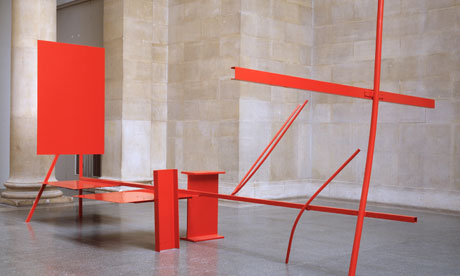
That sculpture needs to be felt by getting around it now appears self-apparent, however for bigger work the expertise of landscape ended up being to be much more crucial than the expertise of pottery, for walking and climbing engages the entire body. Moore’s ideal place for his work was the British countryside, and also the reclining mode of lots of his pieces brings up undulating hillsides as opposed to the upright human figure. Moore’s finest student, Anthony Caro, espoused an equivalent horizontality in the vibrantly colored steel sculptures, and that he frequently chose pastoral game titles, for example Early One Morning and Month of May. Caro’s assemblages happen to be in comparison to bits of farming machinery. The American critic Clement Greenberg, stated he instead of Moore was the “Moses” of British sculpture who had “walked in to the Guaranteed Land and spread themself in it”.
Throughout the twentieth century, sculpture did not just be a leading talent %u2013 it found represent a perfect mode of awareness. This, around individual talent and patronage, describes why it’s loomed so large within our culture. Thus we revere “sculptural” architecture, furniture, fashion, poetry and thought.
The guiding principle behind among the bibles from the swinging 60s, Marshall McCluhan’s Understanding Media (1964), was that present day cars, clothes, paperback books, beards, babies and beehive hair styling place the “force on touch, on participation, participation, and sculptural values”. McCluhan should have been inspired by Read’s focus on palpability %u2013 embracing, hugging, fondling %u2013 in The skill of Sculpture (1954). The reality of sculpture was viewed as evidence of its authenticity, and relief from social alienation. All of a sudden traditional easel painting appeared basically to trade in tricksy illusionism, and several modern artists switched their pictures into workmanlike, three-dimensional objects. Frank Auerbach, together with his inches-thick impastos, and Howard Hodgkin, together with his chunky, reclaimed wooden supports, could easily happen to be co-elected in to the RA show. John Latham, together with his book-encrusted reliefs, is incorporated: here the term is created three-dimensional.
For the publish-Moore visual pyrotechnics, the sculpture I am most searching toward seeing is really a condition portrait in the supposed backwoods years by Alfred Gilbert (1854-1934), the neurotic dark equine of British sculpture. Most widely known for that much maligned and sabotaged Eros fountain in Piccadilly, it had been Gilbert around Epstein who required the brickbats. He wound up in exile in Bruges, bankrupt, hungry and alone. In the RA, he’s symbolized through the magnificent bronze Jubilee Memorial to Full Victoria (1887), commissioned for that town of Winchester and quickly vandalised and covered in tarpaulins it wound up inside a corner from the medieval Great Hall. It is a neo-baroque extravaganza at whose heart sits the full, a brooding Buddha. It’s as haunting every of Bacon’s popes or Hirst’s sharks.

 Loading ...