 The Large Guy, just up in the coal mine, looks fit to burst with mirth. Tewhaven fishwife, er candy striped skirt, presents a triumphantly empty basket. Within the factory, the 19th-century cloth weavers pause using their labors prior to the camera’s protracted gaze, however the child within the Glasgow slum cannot keep so still. He leaves a trace of themself, just a little shivering ghost peeping from a entrance in Close, No 46, Saltmarket.
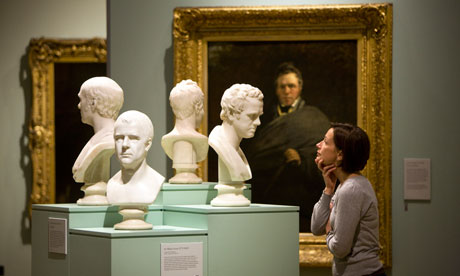
The overlooked, the forgotten, the marginal and also the nameless: these folks of Scotland’s past (and offer) now place their place the very first time within the recently remade Scottish National Portrait Gallery. It’s a radical change, and strikingly democratic. This may also be the most important of all of the many modifications made since 2009 to that particular wallflower of the museum in Full Street.
The Scottish National Portrait Gallery hasn’t been fully loved, a minimum of not in comparison towards the National Gallery, the Museum of Scotland or even the Scottish National Gallery of contemporary Art I and II. The earth’s first purpose-built portrait gallery %u2013 funded through the Scotsman‘s proprietor once the government wouldn’t stump in the funds %u2013 opened up in 1889, an enormous neo-medieval edifice of red-colored sandstone more resembles an ecclesiastical building than the usual museum.
Inside, it might appear sepulchrally dark, the truly amazing hall mainly notable because of its austere brickwork, top of the flooring disorientating using their false roofs and inexplicably blocked-off doorways. The carpets (for example these were) tended to trip you up. It always felt a little heavy around the Scottish lairds, a little light around the moderns and it didn’t contain what’s surely the country’s most well-known portrait, Henry Raeburn’s The Reverend Robert Master Skating on Duddingston Loch, which appeared to express everything.
A few of the portraits were enthralling, and also the temporary shows might be excellent however the SNPG found stand, in a few quarters, for superlative cheese scones. Becoming an adult in Edinburgh, I recall hearing it acidly known to because the overflow tearoom to Jenners. But previously 2 yrs your building continues to be completely remodelled, flooring and walls changed, small art galleries produced, large art galleries superbly brightened with Brought systems and also the plentiful daylight now entering with the new roof. The Museum of Antiquities has moved out, opening 60% more space. And it is excellent library continues to be introduced wholesale in the top floor towards the center from the building, full of wonderful sculptures and strange curiosities, such as the dying masks of Voltaire and grave thieves Burke and Hare. The library has become available to the general public. Which is really as symbolic because the 2,000 gold stars that now twinkle within the once-dour great hall. It works out that they are ever present without anyone’s knowledge, but simply needed some attention. The museum has opened up up, introduced its portraits %u2013 its people %u2013 from the shadows.
Therefore it now shows, for example, not only the textbook Mary, Full of Scots but images of her confidantes, husbands, advisors and detractors, particularly her enemy John Knox, to provide a far more intimate feeling of her existence. It offers a superior not only the 18th-century painter Allan Ramsay, in self-portrait, but his father, spouses and several buddies (such as the philosopher David Hume, off-duty inside a velvet cap to help keep his bald mind warm) to ensure that his milieu, along with the evolution of his style, emerges.
And nearby you will discover Rousseau, colored by Ramsay for Hume once the Scot introduced the Frenchman to Britain to flee persecution in 1765. And Bonnie Prince Charlie, getting away Scotland for that region, drew by Ozias Humphrey in 1776 like a dropsical old drunk whoever bloated face you are able to nevertheless see traces from the Youthful Pretender.
Connections and mix-connections develop everywhere. This is actually the humble likeness of James Wilson, the Lanarkshire weaver who found fame among the Radical Martyrs, hanged for protesting against unemployment in 1820 and also the grandiloquent portrait from the hanging judge. Listed here are the fishwives of Hill and Adamson’s famous calotypes near an oil portrait from the Scottish suffragette who’d bring their successors to protest working in london.
Portrait pantheons depend on words in addition to images. You read of John Campbell, cashier towards the ultra-loyalist Royal Bank of Scotland, who brazenly cashed �6,000 for that Jacobites in 1749. You find out how the Enlightenment philosopher Adam Ferguson affected Karl Marx, the way the geologist John Hutton demonstrated within the late 1700s the Earth should be a lot more than 6,000 years of age, as commonly thought.
Sometimes the wall texts make a lot of biography, downplaying the image for that person. Nothing consists of the stunning little still existence of rocks and fossils in Raeburn’s painting of Hutton, for instance, or even the amazingly free brushwork in David Wilkie’s self-portrait.
The SNPG shouldn’t be so timid about its works of art. From Nicholas Hilliard’s devastatingly subtle James Mire and that i to Wyndham Lewis’s hieratic Naomi Mitchison, scowling impatiently, the museum is filled with great pieces of art.
However, the brand new inclusivity enables for many real facts. The area dedicated to Scotland’s first portrait painter fills the imagination. George Jamesone (c 1589-1644) analyzed having a decorative painter in Aberdeen. The SNPG includes a fragment from the Libyan Sibyl he colored for any Burntisland house, later the place to find Mary Somerville, 19th-century researcher.
Jamesone’s portraits are hardly Van Dyck, unsurprising because of the isolation of those early artists. But his self-portrait %u2013 leaning forward, alert and highly mindful as though dwelling in your every syllable %u2013 is really a no wonder.
The brand new photography gallery introduces the 1800s as nothing you’ve seen prior: schoolboys, crofters, fish poachers, ladies in lengthy skirts scaling Salisbury Crags. Thomas Annan’s Saltmarket series may be the first slum record and you will find other by divine intention famous images, most breathtakingly AG Buckham’s aerial look at Edinburgh Castle like a sceptred Camelot ringed with silver clouds.
Indeed landscapes possess a heavy presence, as though the SNPG regarded as them as a kind of portraiture by other means. That might be the case with Graham Fagen’s affecting videoMissing, which searches wastelands for lost children. But it’s arguable and distorts the display. Anybody searching for Robert Louis Stevenson, Charles Rennie Mackintosh or JM Barrie might be dismayed to locate them hidden inside a side-room from the coffee shop.
It’s not the curators regard these works of art as trendy decor: I imagine they feel more site visitors will appear their way here than in the past. For this can be a museum of but for the people, Scotland’s family album, in the last crofters on St Kilda’s towards the latest immigrants. Everybody should feel some reference to the 1000′s of faces on show.
You are able to argue using the cast list whatever you like: Gerard Butler although not John Logie Baird? The Twentieth century is especially bizarre, but a museum are only able to use what it really has. If only that one had portraits by Robert Colquhoun, James Cowie or Joan Eardley (to title only three) and also the great film works, say, of John Grierson and Margaret Tait. However the gallery is really superbly restored possibly more financial loans and donations follows, as well as without one the knowledge is wealthy, deep and informative: just understandably from Scotland.

 Loading ...