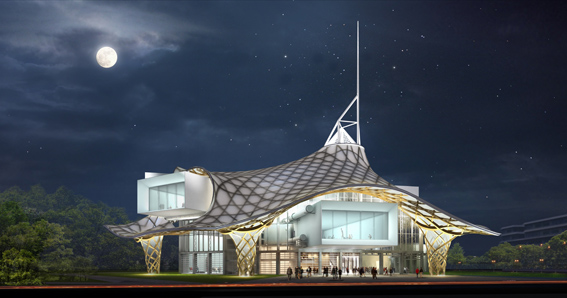
 This is often a very strh. What first strieye in regards to the -Metz is its bizarre, undulating roof. This complex structure, produced from believe it or not than 10 miles of laminated brighten and larch, is certainly an amazing creation, drooping inside the concrete, steel and glass core in the building in the apparently random fashion, as if a passing bird had dropped an enormous floppy hat on its mind.
Covered in fibreglass, the roof remains created as much for basic reasons for aesthetic ones – to keep sun, rain and snow away. It’s, I am unable to help thinking, the building’s best and several redeeming feature. Close-up and inside, concrete, steel and glass dominate, while every glance upwards allows another understand this glorious timber form.
The Pompidou Center in Paris, opened up up in 1977, is probably the favorite art galleries in the world. Therefore it seems sensible it will choose to develop – creating this regional outpost in Metz, north-east France, a short, sensationally fast (1hr 25mins) TGV ride in the capital. The Pompidou-Metz, rising as though within the ocean as being a great conch, was created to spread out three years ago, but such experimental architecture rarely goes exactly to plan, which i suspect that roof might be to blame. It is seven years since the design contest was won having a team made up of Shigeru Stop (Tokyo, japan, japan), Jean p Gastines (Paris) and Philip Gumuchdjian (London). Their curious new building, due to open the next month, is merely two minutes walk within the town’s magnificent central station, designed as being a castle by German architect Jürgen Kröger at the begining of 1900s.
Similar to the initial Pompidou was produced to reinvent a substantial portion of central Paris, and so the Pompidou-Metz forms the centrepiece in the city’s amphitheatre quarter, a place formerly provided to industry. It’s, by any standards, an important building: much cultural pride rides on its curving shoulders, in your town and across the nation. Too for Metz, an urban area this really is this is not on the conventional tourist beat, this can be a chance to reinvent itself.
This is also true the completely new gallery accomplish it? Beneath that hat, the structure at first feels everywhere, its galleries, coffee houses, book stores and intervening public spaces rushing off in many directions. Fishier and fishier. Yet some type of logic does start to emerge. One makes its way into a lobby, while using usual cafe, bookshop and so on, before entering the forum, a soaring space for showing large-scale installations (because the roll-out of Tate Modern’s Turbine Hall, every gallery needs one). Above and through this huge space, three huge concrete tubes crisscross, with home home windows at either finish. Fundamental necessities three principal galleries, showed up at by stairs or lift inside the central 77-metre tall tower, which stands like the mast about the ship, skewering your attention. Each space remains carefully crafted to supply presented sights in the city’s monuments, including Kröger’s fairytale station.
What curious galleries they’re: concrete corridors up depending, with a great degree, on artificial lighting inside an era when it’s commonplace for galleries to demand diffused daylight everywhere. Stop highlights the advantages: these galleries have the freedom of posts, or any other interruption, so offer seamless spaces for featuring art. Regardless, this really will probably be as radical a building since the original Pompidou, which stunned the earth having its own large idea: wearing its insides outdoors, it searched for out all the world as being a gaily colored North Sea oil rig.
The designers were confident with the amazing story of Metz itself when putting their design together. Perilously near the border with Germany, Metz has changed hands many occasions. These feelings of flux invades the fabric from the new building – inside the sense that there’s nothing wholly certain here and anything, culturally, can occur. The funding reflects this flux: although basically a French project, the €69m (£61m) Pompidou-Metz has furthermore been funded with the EU.
Five centuries of pieces of art
Its tall tower leads up to roof cafe-restaurant, a viewing gallery, together with a studio intended for live performances, particularly from the experimental type. From up here, the structure feels and appears a great deal a lot more like the big surface of the circus, with sights to new designed gardens grown with cherry trees. Throughout, though, this is often a strange and ambivalent building. It is the sensation to become a magazine of bits instead of a considered, tightly edited volume. This may function as the purpose: such spatial oddity and aesthetic uncertainty goes, In my opinion, for the heart in the Pompidou-Metz project. The idea here’s that anything might go – that art, architecture and curatorship is certainly a journey rather than an ordained or highly governed experience.
Like its predecessor, the Pompidou-Metz will need getting used to. Much, clearly, triggers the conventional and quantity of what continues show the initial major exhibition will probably be an ambitious try to uncover do not know masterpiece by showing 800 artworks attracted previously five centuries. What’s certainly, though, is the gallery is not some opportunistic franchise, there to learn in the Pompidou title, but an art center by itself, intended by having an identity greatly its.
Despite the fact that product of team performance, the appearance bears the majority of the tips of Stop, a u . s . states-educated Japanese architect celebrated for his use unforeseen materials: houses created from recycled paper tubes, a museum created from 156 shipping containers. Stop gets the knack of conjuring inventive structures from almost no. The Pompidou-Metz, and certainly its roof, is greatly his kind of structure.
Stop describes it a “crustacean”. Once I think back as of this provocative new building within the gaping mouth of Metz-Ville station, sunlight flashes off its roof, which causes it to be vanish so to speak – as if it had slid to some primordial sea.
From Venice to Vegas: Other gallery outposts
The idea of creating branches of established museums is not a completely new one. In 1969, Peggy Guggenheim handed the collections in their Venetian palazzo to her uncle Solomon, which causes it to be a European outpost of his famous A Painter-designed museum in New You’ll be able to. London’s Tate opened up up its first regional outpost, Tate Liverpool, in 1988, in the magnificent warehouse given a transformation by James Stirling. Tate St Ives, produced by Evans and Shalev, adopted five yrs later.
The Peggy Guggenheim Collection in Venice as well as the regional Tates are galleries utilizing their own special figures, collections and shows it may be unfair to give them a call clones. But what’s changed lately is the idea of the museum or gallery “franchise”: a branch in the Guggenheim, Louvre or Hermitage borrowing shows, nearly all its ideas and content, and, first and foremost, its title in the parent institution.
Since the the 19 nineties, the Guggenheim has opened up up new branches around the globe, during Las vegas (failing: it closed in 2003)egas appeared to become host for the hybrid Guggenheim Hermitage Museum, which closed in 2008. Frank Gehry designed the interest-popping branch in Bilbao, while future Guggenheims they’re being built in Guadalajara, Mexico (due to open this season) and Abu Dhabi (Frank Gehry again, 2011). The initial major Louvre branch, an enormous mushroom produced by Jean Nouvel (below), takes shape in Abu Dhabi for 2012. London, the Victoria and Albert museum is likely to venture during the night confines of South Kensington: the initial V&A “abroad” will probably be built-in Dundee, Scotland.
In architectural terms, the danger is always that it might be pricey, over-the-top prots, parachuted into far-off nations without any subtlety which originates from designers working within the confines and discipline of urban centers they do know well. Given carte blanche, there is a inclination to produce something a little too willful or impermanent.

 Loading ...